

Organic Spa Alternatives for Holistic Wellness
Table of Contents
- What to Look for in an Organic Spa Alternative
- Medical Spa vs Day Spa Benefits: Which Model Fits You?
- Why a Holistic Wellness Spa in McKinney Changes the Experience
- Organic Skincare Treatments That Go Beyond the Surface
- Service Menu Comparison: Massage, Acupuncture, Physical Therapy, and Aesthetics
- Pricing and Membership Flexibility: What to Ask Before You Commit
- Ingredient Transparency and Sustainability Practices to Verify
- Frequently Asked Questions
Last Updated: September 20, 2026
What to Look for in an Organic Spa Alternative
If you’re searching for organic spa alternatives, you want more than a pretty treatment room: lasting results, personalized care, and a team that treats your body as a whole system. At C3 Wellness Spa in McKinney, we blend traditional spa services with advanced medical and therapeutic treatments. The best organic spa alternative pairs clean, natural ingredients with licensed clinical expertise, measurable outcomes, and flexible scheduling.
Most people compare service menus and prices, but the right question is whether the provider can address the root of your needs. A facial can calm irritated skin; a consultation that identifies the trigger can help manage your skin concerns.
Here’s what separates a genuinely useful alternative from a prettier version of the same thing:
- Clinical credentials on staff. Look for licensed physical therapists, massage therapists, acupuncturists, estheticians, and medical professionals.
- A real intake process. A provider that asks about your injury history, medications, and stress load before recommending anything is a provider worth your time.
- Integrated care. One team that can coordinate between your pain management and your skincare prevents the “everyone is guessing” problem.
- Transparent ingredient sourcing. You should be able to ask what’s in a product and get a straight answer.
- Flexible commitment. Memberships and passes should adapt to your schedule, not lock you in.
American Academy of Dermatology skincare resource library
Medical Spa vs Day Spa Benefits: Which Model Fits You?
The core difference between a medical spa and a day spa is who directs your care and what outcome you’re chasing. A day spa focuses on relaxation and general skin maintenance; a medical spa adds clinical oversight, so treatments target specific conditions rather than only pampering you.
Neither model is better in the abstract. The right choice depends on your goal.
|
Your Goal |
Day Spa Model |
Medical Spa Model |
|---|---|---|
|
Stress relief and relaxation |
Strong fit |
Also available |
|
Chronic pain management |
Limited |
Strong fit |
|
Anti-aging and skin correction |
Basic |
Advanced |
|
Insurance or VA coverage |
Rarely |
Accepted |
|
Quick single visit |
Easy |
Requires intake |
If your only goal is a relaxing afternoon, a day spa does that well and usually costs less.
Why a Holistic Wellness Spa in McKinney Changes the Experience
The C3 Wellness Spa is a holistic wellness spa in McKinney that treats your stress, mobility, and skin as connected rather than separate appointments. Chronic pain raises cortisol, which affects sleep, which shows up in your skin. Addressing one without the others leaves results on the table.
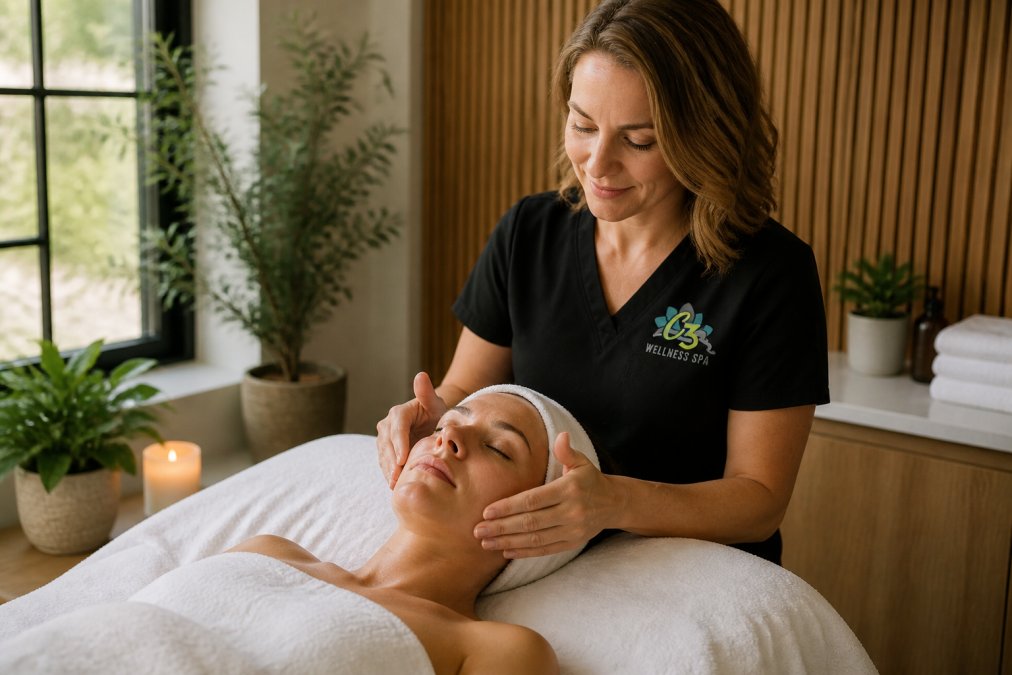
Esthetician performing a relaxing facial on a client at our spa in a serene, nature-inspired room.
Organic Skincare Treatments That Go Beyond the Surface
Organic skincare treatments work best when clean medical grade formulations meet professional assessment. Natural ingredients reduce exposure to harsh additives, but a trained esthetician still needs to match them to your skin type and concern.
Where natural ingredients genuinely help:
- Sensitive or reactive skin that struggles with synthetic fragrances and preservatives
- Long-term skin health, where gentler formulations support the barrier instead of stripping it
- Clients who want transparency about what’s being applied to their face
Service Menu Comparison: Massage, Acupuncture, Physical Therapy, and Aesthetics
Most spa menus list services in isolation, forcing you to guess which fits your problem. A real comparison maps each service to the condition it treats, the sensation during and after, and the realistic timeline for results.
|
Service |
Best For |
Sensation During |
Typical Session Length |
Typical Aftermath |
Realistic Timeline |
|---|---|---|---|---|---|
|
Swedish massage |
General stress relief, circulation |
Light to medium, relaxing |
50-90 min |
Drowsy, loose |
Same-day relief, short-lived |
|
Deep tissue massage |
Chronic muscle tightness, knots |
Firm, sometimes tender |
60-90 min |
Sore for 24-48 hrs |
Cumulative over several sessions |
|
Acupuncture |
Pain signaling, stress, sleep |
Minimal, brief pinch at insertion |
30-60 min |
Calm, occasionally tired |
Often noticeable within 3-6 sessions |
|
Physical therapy |
Strength, mobility, rehab after injury |
Active, you do the work |
45-60 min |
Fatigued but functional |
Weeks to months, measurable milestones |
|
Facial rejuvenation |
Tone, texture, fine lines |
Warm, tactile, relaxing |
50-75 min |
Slight flush, occasionally sensitive |
Visible after 1-3 sessions, maintained ongoing |
|
Body treatments (scrubs, wraps) |
Skin conditioning, full-body care |
Warm, enveloping |
60-90 min |
Soft skin, relaxed |
Immediate cosmetic, short-lived |
Patterns worth knowing before you book:
- Pressure is not the same as depth of result. A deep tissue session that leaves you bruised is not necessarily more effective than a moderate one. The sweet spot is firm enough to reach the tissue layer causing the problem without triggering a guarding response.
- Acupuncture and massage solve different halves of the same problem. Massage changes the tissue; acupuncture changes the signaling. If your tension keeps returning within a week, the tissue isn’t the whole story.
- Physical therapy is the only service on this list that expects homework. If a provider doesn’t send you home with exercises, you’re getting passive care, not rehab.
- Aesthetics is the only category where results compound rather than fade. That’s why a series beats a single visit for skin concerns, and why a single visit is fine for relaxation.
Pricing and Membership Flexibility: What to Ask Before You Commit
Pricing varies widely by provider, treatment type, and session length, so no honest guide can quote a universal number. Ask the right questions before you sign anything.
Questions worth asking every provider:
- Does the membership include rollover for unused sessions?
- What’s the cancellation window, and is there a fee for late changes?
- Can I pause the membership during travel or a busy season?
- Are there different tiers, or is it one flat rate?
- Does the provider accept medical insurance or VA benefits for covered services?
Ingredient Transparency and Sustainability Practices to Verify
“Organic” and “natural” are marketing terms, not regulated ones, on personal-care products, so verification falls on you. Here’s a working framework:
What to look for on a product label
- Ingredient order. Ingredients are listed by concentration, highest first. If the botanical extracts you’re paying for appear after the preservatives, they’re in trace amounts.
- The first five ingredients. These make up the bulk of the formula. If they’re water, alcohol, and synthetic emollients, the “organic” claim is doing heavy lifting.
- Certification marks. Look for recognized third-party certifications, not a brand’s own “clean” badge.
- Fragrance as a catch-all. “Fragrance” or “parfum” can legally hide dozens of compounds. For reactive skin, fragrance-free beats naturally fragranced almost every time.
- Preservative reality. A preservative-free water-based product is a microbial risk unless it’s self-preserving. If a brand claims zero preservatives in a water-based serum, ask how they ensure safety.
What “sustainability” actually means at a spa
Sustainability is broader than the bottle. Verifiable practices include:
- Refillable or low-waste packaging, bulk dispensers, refill programs, or concentrated formats that reduce shipping weight.
- Cruelty-free and vegan formulations, separate claims. Cruelty-free means no animal testing; vegan means no animal-derived ingredients.
- Sourcing disclosure, can the provider name the supplier or region for key ingredients?
- Waste handling, what happens to single-use items like wipes, gloves, and linens?
A verification checklist you can run in five minutes
- Can staff name the active ingredients in the products they use, not just the brand?
- Do they explain why a specific product suits your skin type, or do they recite the same script for everyone?
- Is there a stated policy on refillable or low-waste packaging?
- Do they source from suppliers with published ingredient standards?
- Will they tell you when a natural product isn’t the right tool for your concern?
That last item is the real test. A provider with genuine standards will recommend treatments based on your individual skin needs. This approach prioritizes effective care.
U.S. Food and Drug Administration cosmetics labeling guidance
American Academy of Dermatology skincare resource library
Frequently Asked Questions
How do organic spas differ from regular spas?
Organic spas prioritize natural ingredients, avoid synthetic fragrances and harsh chemicals, and often weave sustainability into their operations. Regular spas may use conventional product lines with preservatives or dyes. The practical difference shows up in skin sensitivity, ingredient transparency, and how treatments are chosen for your skin type. Ask for a skin consultation before booking so the esthetician can confirm which products suit you.
How do medical spa treatments differ from standard day spa services?
Day spa services focus on relaxation: massage, basic facials, body wraps. Medical spa treatments are performed under physician oversight and can include advanced skincare, acupuncture, physical therapy, and IV infusions. If you have chronic pain, an old injury, or want measurable skin results, the medical spa model offers clinical depth. If you only want to unwind, a day spa covers that well.
What should I look for when choosing a wellness spa in McKinney?
Check three things: who supervises the treatments, what credentials the providers hold, and whether the service menu matches your goals. Look for licensed physical therapists, estheticians, and a medical director if you need pain management or advanced skincare. Ask about insurance and VA benefit acceptance if relevant. Also confirm cancellation and rescheduling policies, especially if your schedule changes often.
Can a holistic wellness spa offer both massage and advanced skincare?
Yes. Integrated wellness centers combine therapeutic massage, acupuncture, physical therapy, and medical-grade skincare under one roof. That means your provider can coordinate care, for example, pairing deep tissue work for back pain with a facial rejuvenation plan. Ask whether the team communicates across disciplines, because that coordination is what separates a true integrated spa from a building that rents rooms to unrelated providers.